
The Last Human Out
The cost of being made has fallen to zero. The cost of being seen has gone up. Both ends of the channel are now machine mediated.

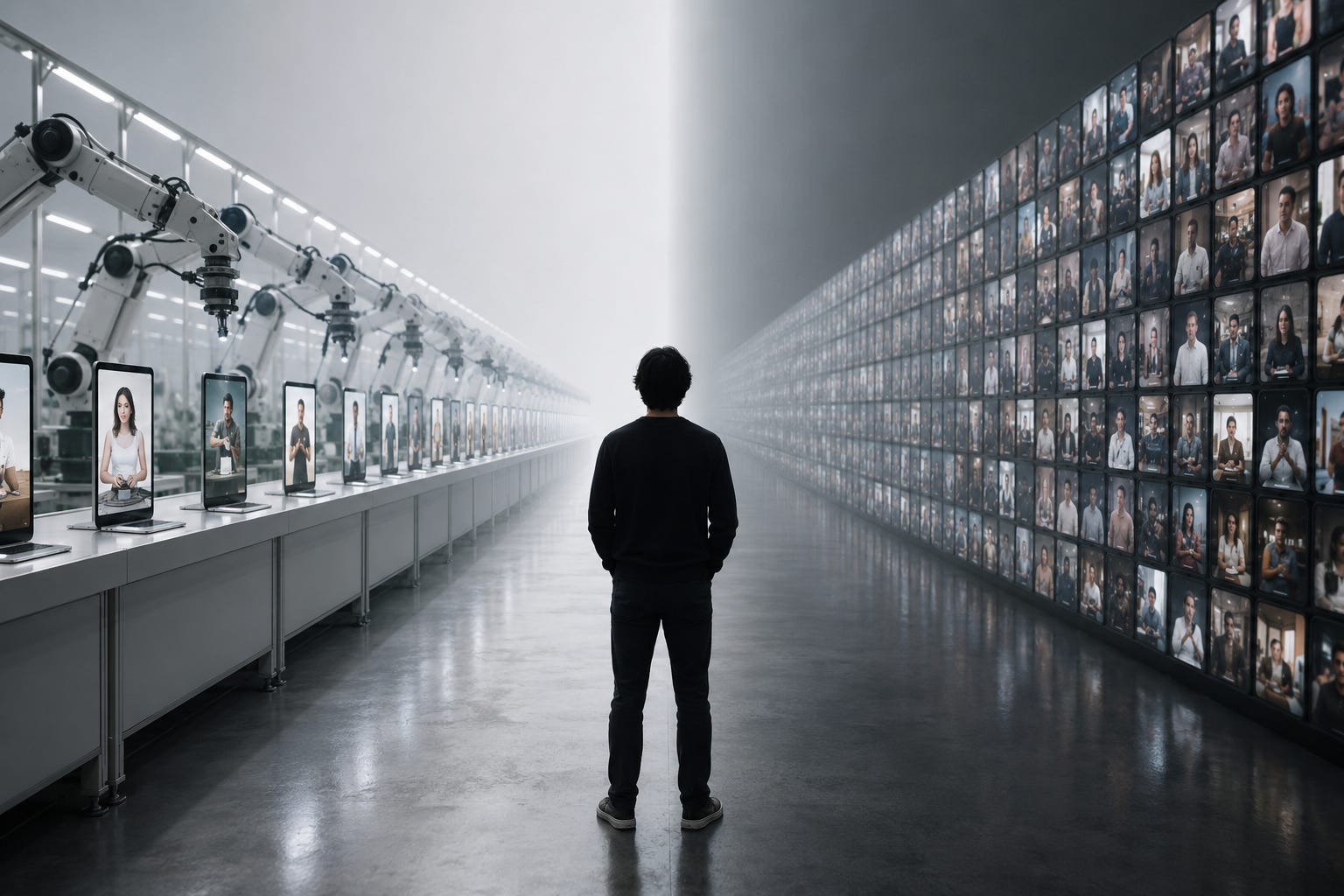
Sean Frank is the chief executive of Ridge, the wallet brand he co founded that has now grown past one hundred million dollars in annual revenue. He has built what he calls a static ad factory. A custom model trained on Ridge’s best performing creative, wired into an automation layer that produces hundreds of new static assets every day with nobody at a keyboard. “We generate 500 static ads per day automatically,” he told the Shopify Masters podcast. “450 of those ads are horrible. We’ll never run them. But the top ten percent are somewhere between five and seven out of ten quality. That’s good enough to get ad spend behind them and test them in market.”
Five hundred assets produced. Four hundred and fifty discarded. Fifty pushed into the Meta auction. The whole pipeline costs less than one freelance designer used to cost for a single weekly batch. Ridge is not a Fortune 500 brand. “The future of advertising,” Frank said in the same conversation, “is just shots on goal.” The infrastructure he is running was, eighteen months ago, the kind of thing only an enterprise marketing department with a six figure agency retainer could put together. Today it sits behind a credit card and an app subscription.
Frank built his factory custom for his brand. The consumer version of the same logic, the one that arrived in the last few months, is a website called Fastlane. You enter your URL. The platform learns your brand in seconds. It generates thirty days of short form video content automatically. It comes with five hundred hyper realistic AI avatars and over two thousand human user generated videos in a searchable library. It schedules directly to TikTok, Instagram Reels, and YouTube Shorts. For an extra fee it sells you warmed up real US accounts, real phones run by real humans, ready to publish in your exact niche. It exposes an API and an MCP endpoint so your AI agent can run the entire loop, generate content, schedule posts, and analyse what worked, without a human ever touching it. The starter plan is twenty nine dollars a month. Ten thousand builders are already in. Their lead case study is a founder who made and posted a single video through the platform in sixty seconds and hit 31.8 million views.
Frank at Ridge is a craftsman. Fastlane is a factory anyone can rent. The curve from one to the other took less than two years. By the end of 2026 there will be a hundred Fastlanes. By the end of 2027 the default state of marketing content on the open internet will be content that no human has touched at any point in its production or distribution, posted by avatars that are not real, on accounts that are not the publisher’s, optimised for algorithmic feeds that no longer distinguish between human and synthetic origin. Whether that is a problem or a tool depends entirely on who the content is for, and most marketing teams are answering that question backwards.
The cost of being made has fallen to zero. The cost of being seen has gone up. Most marketing organisations are optimising the wrong side of that equation, and the gap between the two costs is widening every quarter.
What the curve actually looks like
The capability gap between a one person company and a multinational has, for production purposes, closed inside twenty four months.
Pieter Levels runs a portfolio of products from Bali at around three million in annual revenue with no employees and no agency. Midjourney reached roughly two hundred million in revenue with around eleven people. Forrester’s Total Economic Impact study on Adobe Firefly found enterprises scaling asset variant production by seventy to eighty percent and cutting review time by up to seventy five percent over three years. IBM ran a Firefly pilot that produced two hundred assets and over a thousand marketing variations from a single creative brief, with the resulting campaign delivering engagement twenty six times above benchmark. Estée Lauder deepened its Adobe partnership through 2024 and 2025 to handle the hundreds of thousands of assets a year its twenty five brands need across markets.
The solo operator and the global enterprise are running the same machine. The cost per asset has fallen by roughly two orders of magnitude. Anthropic cut Claude Opus pricing from fifteen to five dollars per million tokens on input at the launch of Opus 4.6 in February 2026, a sixty seven percent reduction at the flagship tier. Google made Gemini Flash nearly free. Models that cost sixty dollars per million tokens in early 2024 now have equivalents at one to two dollars. Carta data shows solo founded startups went from twenty three point seven percent of new ventures in 2019 to thirty six point three percent by mid 2025. The denominator of brands is exploding because the cost of starting one has collapsed.
Mark Cuban put the structural consequence bluntly earlier in 2025. In categories with low barriers to entry, AI compounds the problem by flooding saturated markets with new competitors while shrinking the customer pool available to each one. Restaurants, fashion labels, consumer goods. He calls those categories dead. He is half right. The flood is real and the margin pressure is real. What he misses is the other side of the equation. The cost of production has collapsed. The supply of attention has not.
Adobe surveyed two thousand eight hundred and forty one marketers across seven countries. Two thirds expect content demand to quintuple between 2024 and 2026. The supply of marketing content is rising fivefold. The number of hours in a person’s day has not moved. The cognitive bandwidth available to attend to brands is, at best, flat. When supply rises against fixed demand, the price of being noticed rises and the cost of being mediocre falls to zero. Performance marketing channels have been running this experiment in real time. The CFO who looked at the IBM case study and saw a path to producing ten times more advertising for the same money has not yet noticed that the cost per unit of attention captured is moving in the wrong direction.
This is the 2016 programmatic story replayed at higher velocity. The shift from manually placed media to programmatic was supposed to be a margin opportunity for brands. It became a margin opportunity for platforms. The shift from human produced creative to AI generated creative will follow the same trajectory on a faster clock. By the end of 2026 every serious operator in every category will be running the same factory. The variant itself stops being the edge. The winners are not the brands. The winners are Meta, Google, TikTok, and the picks and shovels companies selling the generators.
Three audiences, three machines
The audience for marketing content has split into three groups that share almost nothing in common.
The first group is humans paying attention. This is the audience marketing has historically been written for. People who notice brands, form preferences, develop loyalty, and choose. For this audience the trust penalty on AI generated content is real and measurable. The Interactive Advertising Bureau study from late 2025 found eighty three percent of ad executives now deploy AI in the creative process, up from sixty percent the year before. Gen Z attitudes moved in the opposite direction. The gap between advertiser adoption and audience trust is widening every quarter. The McDonald’s Netherlands AI generated Christmas advertisement pulled within days of launch in December 2025 is one data point. Coca Cola running back to back AI Christmas campaigns through 2024 and 2025 against documented public criticism is another. The pattern is consistent and the audience reaction is not changing.
The second group is humans not paying attention. The performance advertising audience. The scroll past, swipe, dismiss audience that interacts with thousands of ads a week and barely notices any of them. For this audience AI generated content works. IBM’s twenty six times engagement uplift is real. Ridge’s fifty good ads a day out of five hundred is a working pipeline. This layer is industrialising and the floor of competence is rising fast. The brands operating at this layer who refuse to industrialise will lose ground steadily to the ones who do.
The third group is the one most marketing functions have not yet internalised. Agents acting on behalf of humans. Bain analysed around five hundred million LLM citations and found eighty nine percent of unbranded prompts surface non brand owned media. A senior Pernod Ricard digital leader discovered in 2024 that two thirds of Gen Z and over half of millennials were already using LLMs to research products. When the company commissioned an audit of what the leading models said about its liquor brands, the findings were either incomplete or wrong. Glossier, SKIMS, Spanx, and Vuori are now running direct discovery and transaction flows through ChatGPT without retail intermediaries. Shopify merchants and Etsy sellers are gaining the same capability through the Agentic Commerce Protocol from OpenAI and Stripe and the Universal Commerce Protocol from Google.
The agent audience is growing faster than any marketing function has internalised, and the agent has nothing in common with the human shopper. The agent does not respond to a beautiful advertisement. It reads structured data, citation graphs, schema markup, third party validation, and verifiable claims. Pages with proper structured data are easier for models to extract, cite, and act on. The production stack for reaching this audience looks closer to technical documentation than to marketing.
These three audiences cannot be served by the same function. They require different production stacks, different talent, different KPIs, different reporting lines. A unified marketing organisation trying to serve all three through the same agency and the same dashboard will fail at all three. This is the organisational story most CMOs have not yet noticed. They are still running one team and one budget against three audiences that have already pulled apart.
What the agency machine got right
I spent most of the last twenty years building and running the marketing technology side of brands operating at scale. Nokia and Microsoft in the years when those companies were running enormous integrated campaigns across phones, software, services, and developer ecosystems. UEFA and Art Basel in the years when global sport and global art were learning to operate as digital first brands. The organisations were different. The machine was the same. Large creative agencies, large media agencies, large PR firms, large communications teams, distributed production companies, localisation networks, asset management systems, and the long human chain of judgement that decided what should exist, what should be made, and what should be released into the world.
That machine looks expensive and slow by the standards of Fastlane and the Ridge factory. It was. It was also doing something that the consumer version of the same technology does not do. The agency machine had to decide what to make. The brief was the unit of work. The concept was the unit of value. Production was downstream of judgement. When the judgement was good, the production was worth paying for. When the judgement was bad, the production was wasted at scale. The cost of the machine was, in large part, the cost of the judgement layer that decided what should exist.
That judgement layer is the part of the work that AI does not replace. Concepting, prototyping, ideation, internal brainstorming, the back and forth between strategy and creative, the workflow operations underneath all of it, these are the parts of the agency machine where AI is now extraordinarily good. The marginal cost of producing competent strategic work, of running scenario analysis on a campaign idea, of generating fifty concept variants for a creative team to react to, of drafting and redrafting copy at speed, has fallen by orders of magnitude. The agencies and brand teams that integrate this layer well will produce better work, faster, with smaller teams.
What has changed is what crosses the line into the world as a finished asset to be consumed by a human. The agency machine had a line. The brief crossed it. The concept crossed it. The strategy crossed it. The finished film, the finished campaign, the finished launch, was made by humans because it had to be consumed by humans and the humans on the receiving end could tell the difference. Fastlane erases that line. The brief, the concept, the strategy, the asset, the avatar, the account, the schedule, and the analytics all sit inside one twenty nine dollar a month subscription. The line between internal workflow and external publication has gone. The thing that gets posted to the audience is the same thing the AI generated five minutes earlier.
The agency machine, for all its expense and inefficiency, was a structure that kept human judgement on the production side of the line. The factory model erases the line. Most CMOs reading this are still running structures that assume the line exists. They are signing off on briefs and trusting that the production pipeline behind the briefing carries human judgement through to the finished work. In a Fastlane world, it does not. The brief enters the machine and the work exits the machine and no human has touched any part of what the audience will see.
The holding companies have already moved
Two forces are dismantling the agency machine at the same time. Fastlane erases the line at the small end. The holding companies are restructuring around the same logic at the large end. The pattern is visible in every major announcement over the last six months and the speed of it is what most CMOs have not yet absorbed.
Omnicom completed its thirteen billion dollar acquisition of Interpublic Group in November 2025, creating the largest marketing services company in the world at over twenty five billion dollars in combined revenue. The merger eliminated four thousand jobs. Legacy agency brands including MullenLowe, FCB, and DDB were retired. In January 2026, Omnicom launched the new Omni platform at CES, integrating Acxiom’s deterministic identity data, the Flywheel Commerce Cloud, and IPG’s Interact workflow engine into what the company explicitly calls an “agentic AI operating system” running on 2.6 billion verified IDs and 73.5 billion dollars of annual media buying power.
WPP launched WPP Open and Agent Hub at the same event. Over 75,000 internal users by early 2026. Built on the InfoSum federated data architecture. Cindy Rose, the former Microsoft executive, was brought in as CEO to drive the transition. The group is restructuring under “Elevate28” into four units: WPP Media, WPP Creative, WPP Production, and WPP Enterprise Solutions. Havas launched AVA in the same window, a controlled gateway to multiple foundation models for agency staff and clients. Publicis announced its $2.5 billion all cash acquisition of LiveRamp on 17 May 2026. The deal language is explicit. “Data co-creation for smarter agents.” “Agentic business transformation.” LiveRamp connects 25,000 publisher domains and 500 plus technology and data partners across 14 markets, with 800 clients including more than 25 percent of the Fortune 500.
These are not technology adoptions. They are structural pivots away from the creative service business and toward the data and identity infrastructure that makes brands legible to agents. The big six holding companies have become the big five. The remaining five are competing to own the documentation engineering layer the next decade will run on. None of them are competing for the patronage layer. That is being left to brands and to a handful of specialist studios. The bifurcation is already underway at the top of the industry, and the people running the holding companies have priced it into their balance sheets at well over fifteen billion dollars of acquisitions in the last six months.
The CMO who is still buying creative services from a holding company that is, in the same building, restructuring itself into a data infrastructure business has a problem the slide deck has not yet acknowledged. The seller has already concluded that the thing they used to sell is not where the value is.
What the internet becomes on the other side
Every flood has an opposite
Every flood produces an opposite reaction. The pattern is consistent enough to be useful as a forecasting tool. When the cost of producing a category of content collapses, three things happen in sequence. The category becomes background noise. New forms emerge that explicitly refuse the conditions of the flood. The premium economy reorganises around those new forms while the old forms compress to commodity.
Mass print collapsed the cost of the written word and the reaction was the rise of the signed novel, the literary magazine, the named columnist, and eventually the long form journalism that defined twentieth century non fiction. Photography collapsed the cost of the recorded image and the reaction was painting becoming abstract, conceptual, installation based, and performance led. Television collapsed the cost of moving image distribution and the reaction was cinema becoming auteur driven, festival oriented, and arthouse led. Recorded music collapsed the cost of audio distribution and the reaction was the live concert economy becoming the centre of musician income. The internet collapsed the cost of publishing and the reaction was the rise of platform curation, then the creator economy, then paid newsletters, then private communities. Every flood produces its opposite. The opposite is where the next durable form lives.
Three reactions, already underway
The AI content flood is producing its opposite in real time and the shape is already visible. Three reactions are running in parallel.
The first reaction is the migration of attention to long form, identifiable, embodied media. YouTube interviews running ninety minutes or three hours. Podcasts hosted by named individuals the audience has trusted over years. Long form video essays. Documentary series. The Joe Rogan deal with Spotify, the Lex Fridman conversations, the Trevor Noah podcast, the explosion of founder led shows. These formats resist the flood because duration is the proof. A three hour conversation cannot be synthetically faked, not because the technology cannot approximate it, but because the audience knows the form is too long and too contextual to be machine made. The longer the form and the more identifiable the host, the higher the trust. Attention is migrating toward formats where the audience can verify, by texture, that a person is on the other end. The signed novel and the auteur film are now the named podcast and the ninety minute interview.
The second reaction is the migration of brand investment into the same formats. Apple commissioning documentary and film work. Loewe and Bottega Veneta producing short films alongside their fashion drops. Stripe Press producing physical books. Shopify producing founder documentaries. Patagonia producing environmental films. These are not advertising in the old sense. They are patronage. Commissioned long form work that lives at the trusted end of the attention economy because that is where the audience has moved. The brands that have noticed are moving from a media plan to a commissioning calendar. The brands that have not are still buying performance impressions on the assumption that the same impressions will mean what they used to mean.
The third reaction is the migration of the human web into closed and gated spaces. Substack and the paid newsletter economy. Discord and private community servers. Members only events and live programming. WhatsApp and Slack groups. The growth in these spaces is driven by the simple desire to be in a room with people who can be verified as people. The open web is not dying. It is becoming infrastructure for machine consumption. Cloudflare data and the licensed data deals from Reddit, the New York Times, and Stack Overflow show the open web has already started to behave as training fuel rather than reading material. The human attention layer is migrating to spaces where the door has a check on it. The open web becomes the substrate. The human web moves behind walls.
The brand now has two new jobs that look almost nothing like marketing as practised today. The first is making the brand legible to the agents that increasingly operate on behalf of human buyers in the open substrate. Structured data, citation worthy source material, verifiable claims, transactional rails. This is closer to documentation engineering than to advertising. The second is buying access to the gated human attention layer through patronage, commissioning, live experience, and signed work. This is closer to publishing and impresario work than to media planning. The middle, where most marketing budgets currently sit, is being absorbed by software on one side and abandoned by humans on the other.
The codification of business into agent legible operations is the part of this that most strategy teams underestimate. Within thirty six months, every serious brand will need a structured representation of who they are, what they sell, how their products perform, what trusted third parties say about them, and how an agent can transact on a buyer’s behalf without human intervention. Llms.txt files, schema markup, knowledge graphs, transactional APIs, citation worthy long form content that the major models pull from. The brand that does not exist to the agent does not exist. The brand that exists to the agent but only as a marketing surface, with no structured presence the agent can verify, will be cited unfavourably or ignored. The marketing function as currently constituted does not produce any of this. Someone has to.
The shape of what comes next
The operational picture
Most marketing directors reading this are running a factory pointed at the wrong audience. The last two years of investment have been compounding the wrong asset. The dashboards are reporting the wrong numbers as wins. Acknowledging that is harder than it sounds, because the throughput is real, the cost savings are real, and the slides are easier to defend than the alternative. The alternative is to spend more time and money on fewer pieces of work that nobody else could have produced, to invest in commissioning rather than buying, to treat the brand’s structured presence as a function as important as creative, and to accept that the work that wins in the next three years looks more like publishing and patronage than like advertising.
That is the operational picture. The deeper one sits underneath it, and it is where the structural change actually lands.
Three things follow
Three things follow from the patterns this piece has traced, and the order they will arrive in matters.
The first is the inversion of brand and product. For roughly a hundred years brand has been understood as a wrapper around product. The product is the thing. The brand is the language and imagery used to make humans want the thing. Within five years, in agent mediated commerce, that relationship inverts. The brand becomes the structured truth about the product that the agent verifies before it transacts on a human’s behalf. Specifications, materials, sourcing, third party audits, warranty terms, return policies, comparative performance against competitors. The agent reads this and decides. The Publicis LiveRamp deal and the Omnicom IPG merger are the early proof points. The largest marketing services companies in the world have paid over fifteen billion dollars in cash and equity to own this layer. The thing that humans used to call brand, the meaning layer, the feeling, the recognition, the loyalty, becomes a separate, smaller, more artisanal economy operating in the gated human attention layer. Two things that used to be one. Built by different teams. Measured by different metrics. Sold to different audiences. The conventional marketing organisation is built to do neither of these things and to spend its budget on the layer in between, which is the layer being absorbed.
The second is the return of the patron model. The thing called advertising is a roughly hundred year old industrial format that emerged with mass print, radio, and television. It is not a permanent feature of commerce. Hermès has operated as a patron rather than an advertiser for most of its existence. So has Patek Philippe. So have the luxury houses that have outlasted every wave of mass marketing. The next ten years could see this pattern return at scale. Apple commissioning film. Stripe Press publishing books. Loewe and Bottega Veneta sponsoring craftsmen and film directors. Patagonia underwriting environmental documentaries. Brands earning presence by funding work the audience genuinely values, rather than buying interruptions of work they were already consuming. The advertising industry as currently constituted contracts. A patronage industry grows in its place. The economics work because human attention is the scarce resource and patronage is the only format that humans do not filter out.
The third is the strangest. Both ends of the marketing channel are being absorbed by machines. The production end is AI generating the content. The consumption end is increasingly an AI agent making the shortlist on the human’s behalf. The brand interaction has happened. The avatar has posted. The algorithm has distributed. The agent has read. The shortlist has been made. The recommendation has been delivered. The human has approved. A complete brand experience has occurred without a human being present at any point in the chain. The brand has not been seen. It has been processed. It has not been remembered. It has been logged. The whole vocabulary of twentieth century marketing was built for human cognition. Attention, recall, recognition, preference, loyalty. These concepts assume a human encountering the brand. When the encounter is mostly machine to machine, the concepts may not survive. Something else replaces them. We do not yet know what.
The discipline that has not been named
The deeper question is whether the discipline most CMOs trained for still exists. The marketing function as it has been practised for the last seventy years assumed an audience of humans encountering messages designed for humans, in environments where the humans were the only relevant intelligences. Each of those assumptions is now contested. Some of them are already false. The discipline that survives this is one that has yet to be named, and the people who will define it are not, by and large, the ones currently running marketing departments.
Sean Frank at Ridge built his factory because the maths made sense for his audience. He is correct. Ridge sells a commodity product to a buyer who is mostly not paying attention, and Frank’s job is to win that auction on cost and variance. Fastlane is the same logic priced for everyone else. Both are rational responses to the audience they are reaching. The factory is not the problem. The problem is the marketing director who builds the same factory, points it at an audience that is paying attention, and wonders why the brand is losing equity faster than the production cost is falling.
The factory is the easy part. The harder part is knowing which of the three audiences you are talking to, which one has already been outsourced to a machine, and which one is still made of humans who can tell the difference between work made by someone with a point of view and work made by a model trained on the average of everyone else’s. The hardest part, the one nobody has answered yet, is what the work is even for when both ends of the channel are machine mediated, and what comes next will not be marketing as you have understood it.
If this piece sharpened the picture, subscribe. The next anchor looks at the orchestration layer underneath all of this, and why the brands that win the agent audience will not be the ones with the biggest marketing budgets.
Craig Hepburn is an AI strategist and Perplexity Fellow. Twenty years building at the frontier of digital, from Microsoft and Nokia to Art Basel and UEFA. Now building at the frontier of agentic intelligence.
Indeed, the solution to too much noise is not more noise! There is, however, a middle ground? We treat the AI-generated content simply as the first draft. And then the human iterates, as much as 100 times thereafter. Even if all the iteration is implemented by the AI, IMO, this still elevates the final output significantly above the "slop" threshold, especially if the iterations are evidence-based, not purely subjective. Consequently, operators adopting this discipline end up outputting significantly less, so less noise but better quality from the same original time. That is my definition of better with AI.