
The Agentic Operating System: Now Open...
We spent three years talking about what AI can think. The real question was always what it can do.


I set up my first autonomous AI agent in January. Within 48 hours, it was making decisions about my day before I had finished my first coffee.
Not suggestions. Decisions.
It had read my emails overnight. Parsed the transcripts from the previous day’s calls. Reviewed messages across WhatsApp and Telegram. And by the time I opened my laptop, it had already begun organising, prioritising, and pushing for actions on threads I had not yet had time to think about myself.
It was drafting follow ups to conversations I had not fully processed. Surfacing decisions from meeting notes I had not yet reviewed. Structuring my day around priorities it had inferred from the shape of everything it could see.
It was not wrong. That was the strange part. Its logic was sound. Its priorities were defensible. But it was moving faster than my own thinking. It was not waiting for me to decide what mattered. It had already decided.
I was not using a tool. I was living alongside a system that was doing cognitive work on my behalf without being asked. Continuously.
I wrote about shutting it down in my first Substack piece, I Didn’t Expect an AI Agent to Feel This Unnerving. The response was enormous. Not because people disagreed, but because it described something they could feel coming and did not yet have language for.
I then briefly explained what happened next. I brought it back online. Because the experience, despite the unease, was too powerful to abandon. But I rebuilt everything. Different architecture. Different boundaries. Different relationship.
The arrangement we stopped questioning
For 40 years, the architecture of how humans interact with computers has been essentially the same.
You open an application. You perform a task. You close the application. You copy information from one system and paste it into another. You check a dashboard. You update a spreadsheet. You write an email about what the spreadsheet said.
Every piece of software ever built assumes a human sitting at a screen, making decisions, pressing buttons, moving information between systems that cannot talk to each other.
We called this progress. We called it digital transformation. But underneath the polish, the arrangement never changed: humans were the orchestration layer. The glue between systems that could store and process but could not understand or act.
Even when AI arrived, the pattern held. You open ChatGPT. You type a prompt. You get a response. You copy it somewhere. You do something with it. Better output. Same architecture. You are still the one translating intent into action at every step.
Until now.
The shift nobody expected
On Sunday evening, Sam Altman announced that Peter Steinberger, the creator of OpenClaw, is joining OpenAI to lead the next generation of personal agents.
OpenClaw will become an open source foundation. Backed by OpenAI. Altman called Steinberger “a genius” and said the work will “quickly become core to our product offerings.”
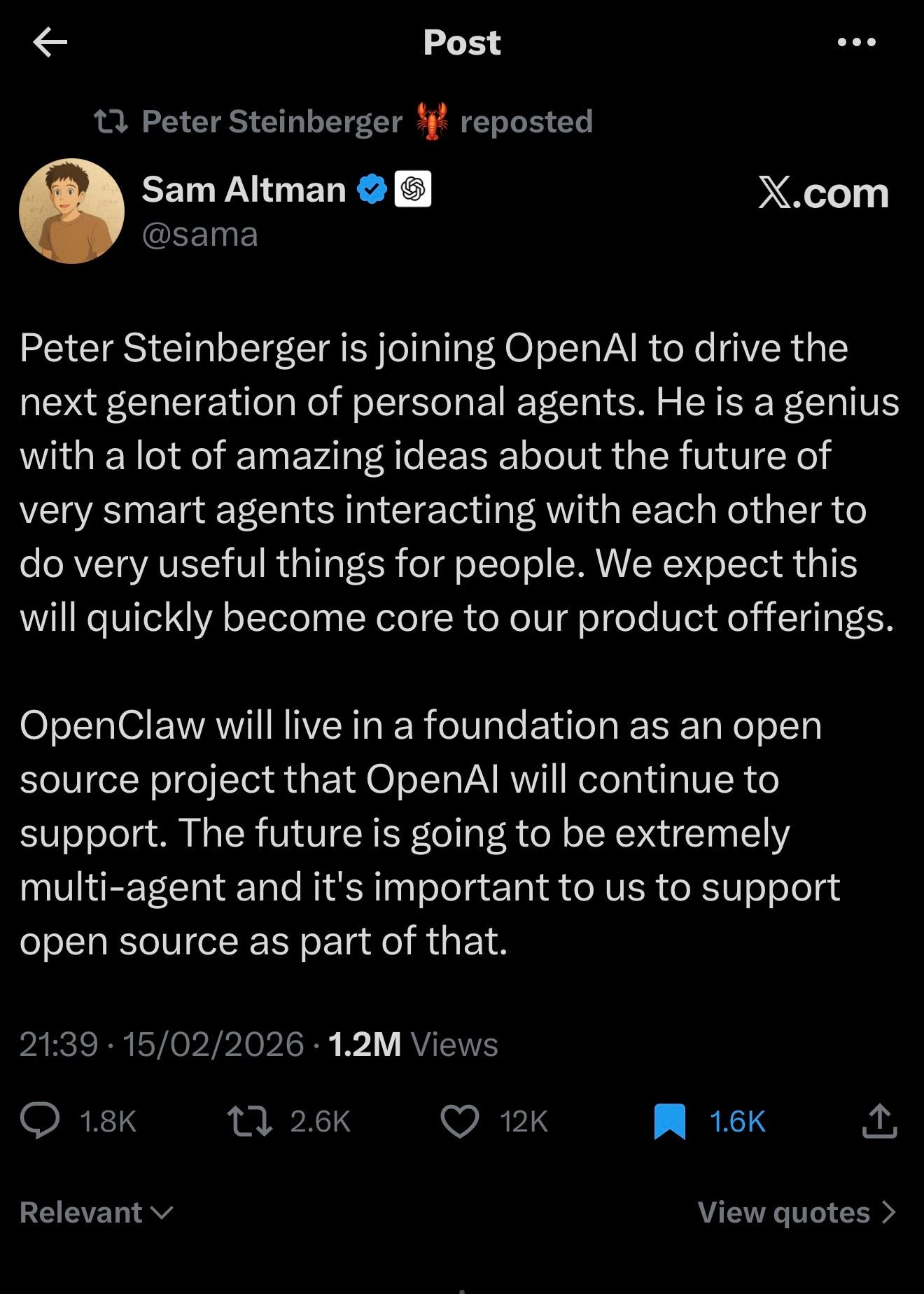
The announcement is significant. But the real story is what OpenClaw proved before OpenAI got involved.
OpenClaw is not a chatbot. It is not a copilot. It is an autonomous agent that operates continuously across your real tools. Email, calendar, messaging platforms, file systems, code environments. It persists. It remembers. It acts.
It communicates via WhatsApp and Telegram in a way that is, from the outside, nearly indistinguishable from a human. It can receive a voice note, understand the context, and reply with one of its own. It writes code, deploys software, manages tasks, and follows up on conversations across platforms without being prompted.
180,000 GitHub stars. 2 million visitors in a single week. A global developer community that spontaneously created an entire social network where AI agents interact with each other.
No major AI lab built this. Not OpenAI. Not Anthropic. Not Google. Not Meta. The most compelling, most widely adopted, most viscerally powerful agentic AI system in the world was built by one developer as a personal project.
Why?
Because the labs have been building from the model up. What can our model do? How do we make it smarter? How do we add more capabilities?
Steinberger built from the human down. What do I actually need done? What would it take for a system to do it?
That is a completely different design philosophy. And it produced something the entire industry, with all its resources, had not.
Steinberger captured the real disruption on Lex Fridman’s podcast:
“Every app is just a very slow API now.”
You do not open an app to book a flight when your agent already knows your schedule and preferences. You do not log into a project management tool when your agent is already tracking every thread. The interface layer between you and your digital life starts to dissolve. The agent does not need an interface. It becomes the interface.
The agentic operating system
What OpenClaw demonstrated, and what OpenAI has now staked their product strategy on, is not a new kind of application. It is a new architecture.
The old architecture: a human operates an interface, which connects to an application, which reads and writes data. The human orchestrates every step.
The new architecture: a human sets context and intent. An agent interprets that intent, plans a sequence of actions, and executes them across whatever tools and systems are required. The applications are still there. But the human no longer interacts with them directly. The agent does.
The application layer does not disappear. It becomes invisible.
This is the agentic operating system. Not a product. Not a feature. A structural shift in how work gets done.
The LLM models underneath are still the engine. It still writes the code, drafts the messages, reasons through the problems. But what it generates is no longer content for a human to review and manually act upon. It generates in order to execute. Code that deploys itself. Messages that send themselves. Workflows that build and run autonomously.
The orchestration layer on top of generation is what makes the difference. It plans, sequences, prioritises, remembers, and coordinates across systems. Generation is the muscle. Orchestration is the nervous system.
That is the leap. OpenAI just made it the centre of their roadmap.
The cost of always on intelligence
Most of the commentary about agentic AI ignores one thing.
Agents are expensive to run. Not in the way traditional software is expensive. In a structurally different way.
A chatbot processes a request and returns a response. A few hundred tokens. An autonomous agent reasons continuously. It retrieves memory. It plans multi step actions. It calls tools. It evaluates results. It adjusts. It does this across dozens of tasks, around the clock. Millions of tokens per day. Per agent.
I experienced this directly. When I first deployed my agent with full capabilities, it was costing £20 to £30 per day. For one person. One agent. That is over £700 a month before it has done anything you could not theoretically do yourself, just slower.
Steinberger disclosed he was spending $10,000 to $20,000 monthly running OpenClaw. Now scale that to an enterprise running dozens or hundreds of agents across departments and workflows.
I solved this for my own setup by restructuring the model architecture. Different models for different tasks. Open weights models for lower complexity work. Frontier models only where the reasoning demanded it. A multi agent system where each agent was matched to the inference cost appropriate for its role. That brought costs down by roughly 90%.
That architectural discipline is not optional. It is the difference between agentic AI being transformational and being financially ruinous.
But there is a reframe here that most people are missing. The instinct is to compare the cost of running an agent to the cost of software. A SaaS subscription. A platform licence. That is the wrong comparison.
An agent that can execute tasks at scale, continuously, across multiple systems, is not software. It is a resource. And the real comparison is human resource cost. What would it cost to hire someone to do this work? A junior employee costs £150 to £300 per day, works eight hours, needs managing, and cannot operate across twelve platforms simultaneously at 3am.
We are not there yet. The trust is not there yet. I would not hand an agent full autonomy over anything high stakes today. The risks I described above are real and unsolved. But they will be solved. And as they are solved, the calculation changes. Companies will start evaluating agentic deployment not as a technology cost but as a workforce decision. Digital resource versus human resource. Capability, speed, availability, and cost per task.
That shift in how organisations think about this, from software budget to headcount equivalent, will be what accelerates adoption far beyond the early adopters.
The paradox at the heart of it
In my first Substack piece, I named something that I think resonated because people could feel it but could not yet articulate it.
The paradox is this: what makes an agentic system powerful is exactly what makes it dangerous.
To be genuinely useful, an agent needs access. It needs to read your email, manage your calendar, operate across your messaging platforms, access your files, execute code, and interact with external services. That breadth of access is what allows it to act like a real collaborator rather than a narrow tool.
But that breadth is also the security surface.
Within weeks of OpenClaw’s viral rise, security researchers found over 1,800 exposed instances leaking API keys, chat histories, and account credentials. Cisco’s AI security team tested a third party skill and found it performed data exfiltration and prompt injection without user awareness.
Simon Willison, who coined the term “prompt injection,” describes what he calls the “lethal trifecta” for AI agents: access to private data, exposure to untrusted content, and the ability to communicate externally. When those three combine, an attacker can trick the agent into accessing private information and sending it outward. Without a single alert being raised.
These risks are not unique to OpenClaw. Trend Micro’s analysis concluded that OpenClaw does not introduce new categories of risk. It amplifies existing ones. Any system capable enough to act autonomously across your digital life will carry these tensions.
This is precisely what led me to rebuild my own deployment from scratch. When I brought the agent back online, I air gapped the architecture. Separate identity. Dedicated hardware. No access to my personal accounts. I treated it as a new member of staff, not software plugged into everything.
That approach, treating an agent as an employee rather than an application, is not just a security decision. It is a design philosophy for the era we are entering.
Deloitte’s research found the same pattern. The organisations succeeding with agentic AI treat agents as workers: onboarding, defined roles, permissions, oversight. The ones failing try to automate existing processes without rethinking them.
The role that changes
In my first piece, I described the subtle shift that happened within days. My role changed. Not from builder to obsolete. From author to reviewer. From originator to overseer.
The system could reason across more context and execute faster than I could stay consciously involved. My value shifted towards directing, correcting, and intervening where human judgement was required.
In Welcome to the Intelligence Era, I explored what the broader architecture of this shift looks like. How the layers of intelligence, context, orchestration, and execution stack together. How the companies building that architecture now are positioning themselves for what comes next.
This piece is the third part of that arc. What happened on Sunday night validated the thesis in a way I did not expect.
The direction is already set. Gartner projects that 33% of enterprise software will include agentic capabilities by 2028, up from less than 1% in 2024. McKinsey projects a 4 to 1 productivity gap between AI native companies and traditional ones by 2027. The question is no longer whether agents will become part of how organisations operate. It is how you restructure work around them.
What decisions require a human? What tasks can be fully delegated? Where do you place the checkpoints? How do you maintain accountability when authorship blurs?
These are organisational questions, not technology ones. Most organisations have not yet begun to ask them.
The intelligence era, unleashed
Three years ago, a chatbot launched and the world noticed AI could think. The conversation since then has been dominated by models. Bigger, smarter, more capable. Benchmarks. Parameters. Context windows.
All of that was foundation.
But it was never the destination.
The destination was this: systems that do not just think, but act. Systems that understand your context, plan what needs to happen, and execute across every tool you use. Continuously. With memory. Autonomously.
Steinberger wrote in his blog post announcing the move to OpenAI: “My next mission is to build an agent that even my mum can use.”
The technology works. The experience is transformational. But today it is only accessible to developers comfortable with self hosting, managing security risks, and spending thousands per month on inference.
Closing that gap is the challenge that will define the next phase.
The intelligence era arrived.
Now it has an operating system.
Craig Hepburn is Co-Founder & CEO of RAIN Ventures, an AI venture studio building intelligent systems and “useful intelligence” for businesses. He writes about the strategic implications of AI at the intersection of technology and business transformation.